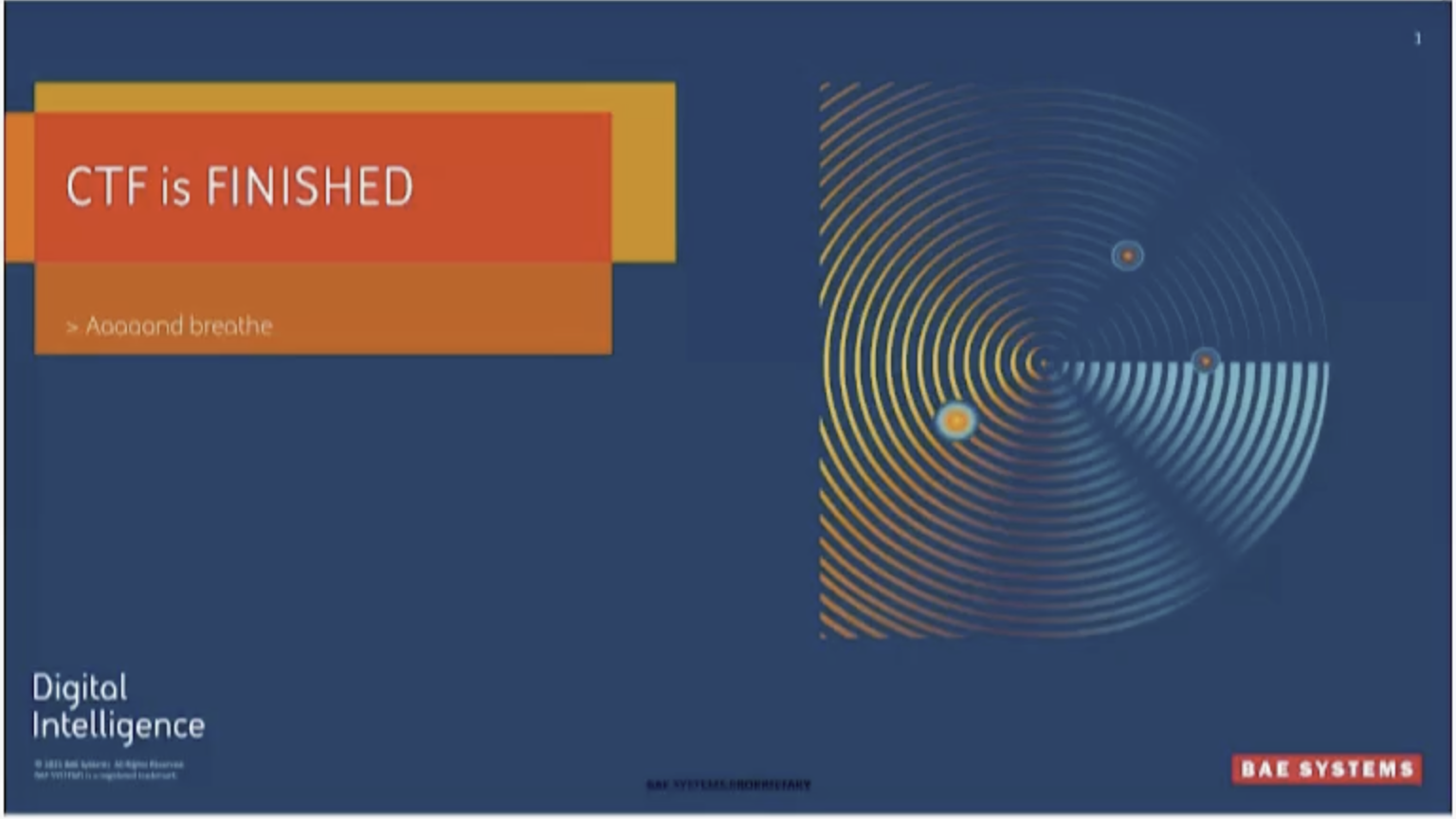
Open University BAE Systems Event: A veteran-turned peace activist was removed from an event involving BAE Systems, raising concerns about protest and free speech at the Open University
In 2014, I moved from England to Northern Ireland / North of Ireland (NI), leaving behind a career in the UK Armed Forces (UKAF). Adjusting to life in a post-conflict society was challenging, especially with fluctuating symptoms of post-traumatic stress disorder. It felt important to learn what I could of the region’s complex history from different perspectives. Much of this was facilitated by my pre-Open University (OU) study at a local university. It was here that I discovered the link between UK Higher Education and arms manufacturers. It didn’t surprise me, but then why would it? I’m a veteran who grew up in an area of England littered with reminders of WWII; a vehicle test track often used for new military vehicles; and an active arms manufacturer nearby. It seemed normal to me. However, the issue with normalisation is that what is ‘normal’ is not usually questioned. I genuinely hadn’t made the connection between the arms being manufactured in my neighbourhood to wreak havoc thousands of miles away until I was thousands of miles away from my neighbourhood. Iraq was a land of contrasts; there were stark differences between rich and poor, what we were told of the people and how they treated us, Western ‘evidence’ of weapons of mass destruction and the truth. The experience taught me an important lesson that I have tried to carry forward in my new life in NI and has been seminal in turning to peace and anti-war activism. I have learned to centre peoples’ lived experience above all else.
UK universities have been involved in weapons research since the First World War (WWI). What was once viewed as a product of necessity soon became a means by which institutions could navigate various financial crises, further facilitated by the dominance of neoliberalism in the 1980s (Ajonye, 2024; Roberton and Lees, 2002; Shewan, 2025). According to Liam Doherty of Demilitarise Education (2023), the shift to increasingly marketised models has contributed to universities’ dependence on funding from both fossil fuel and the arms industries. He argues that while progress has been made in divestment from fossil fuel companies, the same cannot be said for the latter. In fact, student-led divestment campaigns – gaining significant traction since the onset of genocide against the Palestinian people – found that, in the last fifteen years alone, arms companies invested hundreds of millions of pounds into research programmes and collaborations (Larkham, 2024). Universities have also been accused of increasingly authoritarian responses to student protest against the presence of these companies at on-campus events. This has ranged from covert online surveillance to increased securitisation (Boffey and Walkawar, 2025; Shewan, 2025). In 2025, a student protestor at an NI university careers fair faced expulsion amid claims of “abusive, threatening, bullying or harassing behaviour” (Tunney, 2025). Though disciplinary proceedings were later dropped, the matter sparked widespread outrage and inspired more students to act, including me.
Silenced at Open University BAE Systems Event
Moving forward, I joined OU Friends of Palestine shortly after starting my degree with the institution. Having protested against the genocide since it began, I was keen to get involved in the group’s activities, particularly as known involvement of various companies could conflict with the university’s own ethical policies. My opportunity came with the Open University BAE Systems event: Capture the Flag, in February 2026, which had been advertised as a gamified recruitment event by the OU Careers and Employability Service. My aim was to ask people to reconsider their participation, reflecting the rights to freedom of expression, to protest and to peacefully encourage conscientious objection. I had intended to outline my position in the opening presentation (in which it was confirmed by the main speaker as a recruitment event). But when the ‘floor’ wasn’t opened to questions – probably as a result of previous student action – tactics were changed. Anti-climactically, I was ejected from the presentation after making some short statements in its chat feature without managing to get my point across. Moving to the platform to be used for the two-day event, I published a longer statement with my first name and briefly outlining my view. I can’t be certain if it was removed by the group administrators as I was speedily ejected from the whole event. To be honest, it wasn’t unexpected, given the extensive footage of student activists being blocked or forced out of on-campus events. If anything, it is easier to silence OU students as most of our learning and extracurricular activities are online.
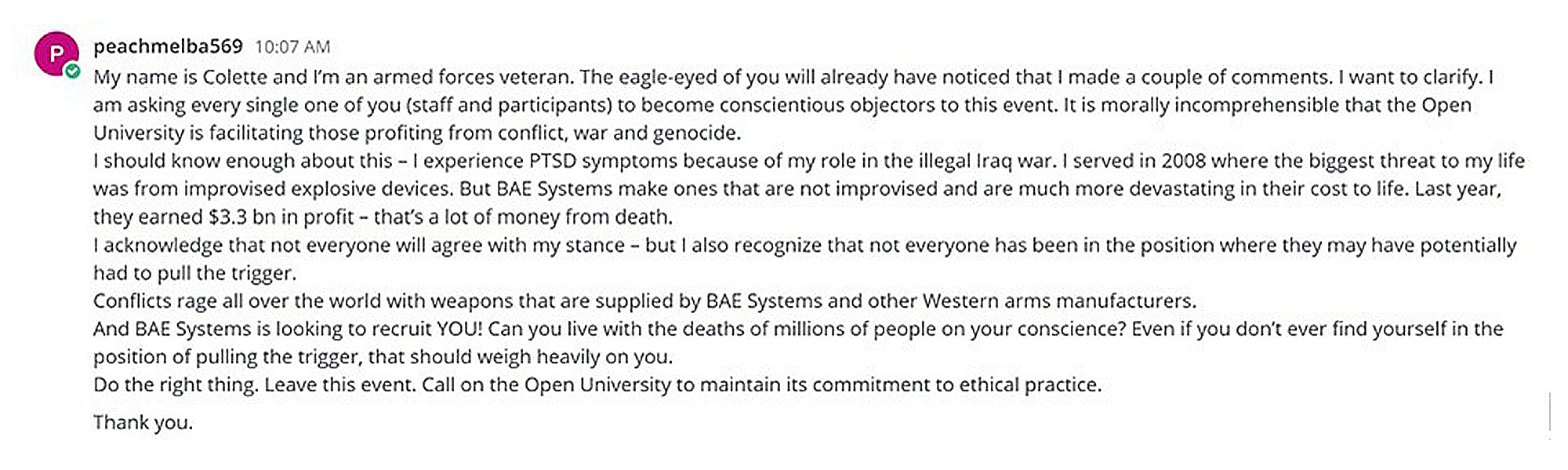
Open University BAE Systems Event: Comment left by veteran-turned peace activist, Colette
My direct contribution lasted less than twenty minutes, though I remained in a support role for other activists for the rest of the weekend. When my statement was reshared on the second day, participants assumed I had rejoined the event using another alias and subjected activists to a tirade of abuse. Some of these individuals also made ethnic cleansing jokes through thinly-veiled analogies, referencing soap, “bath bombs” and companies on the Boycott, Divest and Sanction (BDS) list. None making light of human suffering and genocide, or bullying others were removed by BAE Systems’ group administrators, yet several peaceful activists were without question or warning. This double standard has since been reported to the university as a possible breach of the Higher Education Free Speech Act and as an individual complaint. Though I wait expectantly, I have neither been asked for evidence nor penalised for my involvement in the annual Open University BAE Systems event.
I hope the OU will soon divest from the arms industry. Until then, I’ll keep showing up to challenge professional and financial relationships that are the antithesis of the university’s ethical commitments.
Click here to send an automatic email to OU management, defending students protesting Open University BAE Systems events and calling out their complicity!
REFERENCES
Ajonye, O. (2024). ‘Weaponising Universities: Research collaborations between UK universities and the military industrial complex’. Campaign Against Arms Trade. Available at: https://caat.org.uk/publications/penDemocra-universities-research-collaborations-between-uk-universities-and-the-military-industrial-complex (Accessed: 29 March 2026).
Boffey, D., & Walawalkar, A. (2025) ‘UK universities offered to monitor students’ social media for arms firms, emails show’. The Guardian (8 October). Available at: https://theguardian.com/education/2025/oct/08/uk-universities-offered-to-monitor-student-social-media-for-arms-firms-emails-show (Accessed: 07 April 2026).
Doherty, L. (2023). ‘Investment, Influence and Integrity: how arms industries compromise universities’ research agendas’. Rethinking Security. Available at: https://rethinkingsecurity.org.uk/2023/03/13/investment-influence-and-integrity-how-arms-industries-compromise-universities-research-agendas (Accessed: 07 April 2026).
Larkham, Z. (2024). ‘Students are catching their universities in bed with arms companies’. Novara Media (27 May). Available at: https://novaramedia.com/2024/05/27/students-are-catching-their-universities-in-bed-with-arms-companies (Accessed: 07 April 2026).
Roberton, A., & Lees, C. (2002) Chapter 7: The university, 1939-45, Bulletin of the John Rylands Library, 84(1-2), pp. 447-532. https://doi.org/10.7227/BJRL.84.1-2.9
Shewan, L. (2025). ‘Disciplining dissent: UK universities, the arms industry, and protest’. Scientists for Global Responsibility. Available at: https://www.sgr.org.uk/resources/disciplining-dissent-uk-universities-arms-industry-and-protest (Accessed: 29 March 2026).
Tunney, L. (2025). ‘Student facing disciplinary hearing over pro-Palestine protest accuses QUB of stifling free speech’. Belfast Telegraph (20 November). Available at: https://www.belfasttelegraph.co.uk/news/education/student-facing-disciplinary-hearing-over-pro-palestine-protest-accuses-qub-of-stifling-free-speech/a/112247740.html (Accessed: 07 April 2026).